Getting sharp photos with your camera can be tricky, especially when you’re trying to get super close for macro shots. The neewer 4 way macro focusing rail slider might seem like a complicated tool at first. But don’t worry!
It’s actually a fantastic piece of gear that helps you get those perfect, in-focus close-ups with a little practice. We’ll walk through everything step-by-step to make using it super simple. Let’s get your macro photography looking its best.
Key Takeaways
- You will learn what a neewer 4 way macro focusing rail slider is used for.
- Understand the main parts and how they move.
- Discover how to set it up for different shooting situations.
- Learn tips for achieving sharp focus in macro photography.
- Find out how to care for your slider to keep it working well.
Understanding Your Neewer 4 Way Macro Focusing Rail Slider
The neewer 4 way macro focusing rail slider is a camera accessory designed for precise focusing in macro photography. Macro photography involves taking extremely close-up pictures of small subjects, like insects, flowers, or textures. In this kind of photography, even tiny movements of the camera can cause your subject to go out of focus.
The slider gives you the ability to move your camera forward, backward, left, or right with very fine control. This makes it much easier to find the exact sharpest point for your photo. It’s a valuable tool for anyone serious about capturing the tiny details of the world.
What Is Macro Photography
Macro photography is a photographic technique where you photograph a subject at very close distances. Typically, this means the subject is captured at a reproduction ratio of at least 1:1, meaning the image projected onto the camera sensor is the same size as the actual subject. This allows you to see details invisible to the naked eye.
Think of the intricate patterns on a butterfly’s wing or the delicate veins of a leaf. Achieving sharp focus in macro photography is incredibly difficult because the depth of field is extremely shallow. Even a slight shift in distance can make parts of your subject blurry.
This is where specialized equipment like focusing rails becomes essential for photographers.
The Role of a Focusing Rail
A focusing rail is a device that attaches between your camera and your tripod. It has a mechanism that allows you to slide your camera forward or backward along a track. For macro work, this sliding action is critical.
When you are already very close to your subject, it’s often impossible to make tiny focusing adjustments by just turning your camera’s focus ring. Sometimes, the camera’s autofocus might struggle, or manual focus might be too coarse. A focusing rail lets you make these minute adjustments by moving the entire camera system.
This gives you a level of control that is simply not possible otherwise. It’s like having very precise micro-movements at your fingertips for pinpoint accuracy.
Neewer 4 Way Macro Focusing Rail Slider Explained
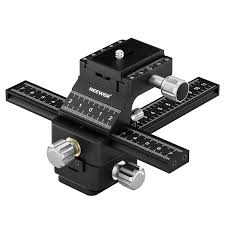
The neewer 4 way macro focusing rail slider takes the concept of a simple focusing rail a step further. Instead of just moving forward and backward, it allows for movement in four directions. This typically means forward and backward movement, and also left and right movement.
Some models might also offer up and down adjustment, but the “4 way” usually refers to the horizontal plane. This multi-directional movement is incredibly useful. You can fine-tune your composition and focus without having to physically move your tripod or the subject.
This is a huge advantage when shooting live subjects, like insects, which might move slightly, or when you need to adjust framing precisely without disturbing anything.
Key Components and How They Work
At its core, the neewer 4 way macro focusing rail slider consists of a base plate, one or two sliding plates, and control knobs. The base plate is what you would typically attach to your tripod head. This plate stays stationary.
Mounted on the base are one or more sliding mechanisms. Each sliding mechanism allows for movement along a specific axis. For example, one slider might move left and right, and another slider mounted on top of that one might move forward and backward.
Small, precise knobs control the movement of each slider. Turning these knobs engages a gear system that moves the plates smoothly. You can lock each slider in place with a locking knob once you achieve the desired position.
This prevents any accidental movement during your shoot.
Base Plate
The base plate is the foundation of the focusing rail. It’s the part that connects directly to your tripod head. Most base plates have a standard tripod mounting screw, usually 1/4 inch, to attach to your ball head or other tripod mount.
Some might also include a 3/8 inch adapter for compatibility with different tripod heads. The plate is designed to be sturdy and stable, ensuring that your camera and the rail system remain firmly attached to the tripod. A stable base is crucial for sharp photography, especially at high magnifications where any vibration can be amplified and ruin your shot.
Sliding Plates
The sliding plates are the moving parts of the rail. You usually mount your camera onto the top sliding plate. The movement of these plates is what allows you to adjust your position relative to the subject.
A typical 4-way slider has at least two sets of sliding plates. One set might be designed to move horizontally (left and right), and another set, often mounted perpendicular to the first, moves vertically (forward and backward). These plates move along precision-machined tracks.
The smoother these tracks are, the finer your adjustments can be. Many sliders also feature measurement markings along the tracks, which can be helpful for reproducibility or for noting specific focus positions.
Control Knobs
The control knobs are your interface for moving the sliding plates. These knobs are typically knurled, meaning they have a textured surface, to provide a good grip. When you turn a control knob, it engages a geared mechanism that pushes or pulls the sliding plate.
The gearing is designed to be sensitive, so a small turn of the knob results in a very small movement of the camera. This allows for the extremely fine adjustments needed for macro focusing. Some knobs also have a locking function.
Turning them in one direction allows movement, while tightening them in the other direction locks the plate in its current position. This locking feature is vital to prevent your camera from shifting once you have achieved focus.
Locking Mechanisms
Locking mechanisms are integrated into the design of the control knobs or as separate levers. Their purpose is simple: to hold the sliding plates firmly in place once you have achieved your desired position. Without effective locks, any slight bump or vibration could shift your camera, ruining your carefully set focus.
The knobs often work by tightening down on a screw that presses against the track or the gear mechanism. This friction holds the plate. When you loosen the knob, the plate is free to move again.
Ensuring these locks are secure is a critical step before you take a shot.
Setting Up and Using Your Neewer 4 Way Macro Slider
Setting up your neewer 4 way macro focusing rail slider is straightforward. First, attach the base plate of the slider to your tripod. Then, mount your camera onto the top plate of the slider.
Once everything is securely attached, you can begin to position your camera relative to your subject. The beauty of the 4-way movement is that it allows for fine-tuning both your focus distance and your framing without disturbing your tripod or subject. You’ll find that this level of control dramatically improves your ability to get sharp macro shots.
Mounting Your Slider and Camera
Start by screwing the base plate of the neewer 4 way macro focusing rail slider onto your tripod head. Use the standard 1/4-inch or 3/8-inch mounting screw that matches your tripod. Make sure it’s snug but don’t overtighten.
Next, place your camera onto the top plate of the slider. Many sliders have a built-in 1/4-inch screw for this purpose, which screws into the base of your camera. If your camera has a vertical grip or a battery plate, ensure the slider screw is positioned to avoid interfering with battery access or other controls.
Once the camera is on the plate, tighten the camera mounting screw securely. You want your camera to be stable and not wobble at all.
Initial Positioning and Focusing
Before you start sliding, get your camera roughly in the right position and frame your subject. Use your tripod’s panning or tilting capabilities to get the general framing. Then, zoom in with your camera’s live view or use a high magnification setting to see your subject clearly on the screen.
Initially, you might not use the slider’s movement for focusing. Instead, use your camera’s native focusing capabilities or make larger physical adjustments to the tripod to get your subject as close to your desired focus point as possible. This pre-positioning makes the fine adjustments with the slider much easier and more effective later on.
Fine-Tuning with the 4 Way Movement
This is where the magic of the neewer 4 way macro focusing rail slider happens. Once your camera is roughly positioned, you’ll start using the control knobs. If your subject is slightly too close or too far, use the forward/backward sliding mechanism to adjust the focus distance.
If your framing is a little off, use the left/right sliding mechanism to recompose. Turn the knobs slowly and deliberately, observing the change in your live view screen. You are looking for that point where your subject is at its sharpest.
Remember to engage the locking mechanisms after each adjustment to prevent any unwanted movement. This allows you to dial in focus with incredible precision.
Achieving Critical Focus
Critical focus in macro photography means that the most important part of your subject is tack sharp. Because the depth of field is so thin, you’re often only focusing on a very narrow plane. The neewer 4 way macro focusing rail slider allows you to move your camera along this plane with extreme accuracy.
Use your camera’s live view with digital zoom to magnify the area you want to be sharpest. As you make small movements with the slider knobs, watch for when that specific area snaps into sharp focus. It’s a satisfying moment when you see it happen.
Don’t be afraid to make very, very small adjustments – sometimes a tiny turn is all you need.
Locking Your Position
Once you have achieved what looks like the perfect focus, it’s crucial to lock down your position. Locate the locking knobs for the sliders you used. Turn these knobs firmly to secure the plates.
This prevents your camera from shifting, which could happen due to vibrations from pressing the shutter button or even subtle air currents. If you are using a remote shutter release or your camera’s timer, this helps further reduce camera shake. A secure lock is your guarantee that the precise focus you found will remain until you take the shot.
Sample Scenario 1 Setting Up for a Flower Shot
Imagine you are photographing a delicate flower. You’ve set up your tripod and attached the neewer 4 way macro focusing rail slider. Your camera is mounted on the slider.
You’ve framed the flower roughly using your tripod’s ball head. Now, you use the slider’s forward/backward control to get the main part of the flower, perhaps a petal’s edge or the stamen, into the general focus area on your live view. Then, you might use the left/right control to slightly adjust the composition so the flower is perfectly placed.
Once you’ve dialed in the sharpest point for your chosen focal plane, you lock both controls. This ensures that when you take the photo, the flower is exactly where you want it and tack sharp.
Sample Scenario 2 Shooting a Stationary Insect
Let’s say you find a small beetle on a leaf, and it’s not moving much. You position your tripod with the neewer 4 way macro focusing rail slider so your camera is close to the beetle. You can now use the slider’s controls for very precise adjustments.
Perhaps the beetle’s head is almost in focus, but its antennae are slightly off. You would use the forward/backward slider to bring the antennae into focus. If, in doing so, the beetle’s body moves slightly out of your desired frame, you can use the left/right slider to recompose without physically touching the tripod or the leaf.
This allows for perfect framing and focus simultaneously. Once satisfied, lock everything down.
Tips for Sharper Macro Photos with Your Slider
Using a neewer 4 way macro focusing rail slider is a big step towards sharper macro photos, but there are other techniques that work hand-in-hand with it. Think about lighting, camera stability, and how you trigger your shutter. Combining these elements with the precise movement the slider offers will make a noticeable difference in the quality of your close-up images.
These tips are easy to implement and will elevate your macro photography to a new level.
Maximize Camera Stability
Even with a tripod, camera shake can be an enemy of sharp macro photos. Use a sturdy tripod that can handle the weight of your camera and lens without wobbling. Avoid extending the tripod’s center column too high, as this reduces stability.
Consider using a remote shutter release or your camera’s self-timer. This prevents you from touching the camera when you press the shutter button, which can cause vibrations. Some photographers even use a cable release to trigger the shutter, further minimizing shake.
A firm base and a steady trigger are essential companions to your focusing rail.
Control Your Lighting
Macro photography often requires excellent lighting. The shallow depth of field means that any blur is very noticeable. Good lighting helps you use a faster shutter speed, which in turn reduces motion blur from camera shake or subject movement.
Use natural light when possible, but be mindful of its direction and intensity. For more control, consider using an external flash, a ring light, or a macro twin-lite. These light sources can provide consistent, bright light directly onto your subject, allowing you to achieve proper exposure even with fast shutter speeds.
Diffusing your light source is also important to avoid harsh shadows and blown-out highlights.
Understanding Depth of Field
Depth of field (DOF) is the range of distance in a photo that appears acceptably sharp. In macro photography, DOF is extremely shallow. This means only a very small portion of your subject will be in focus.
The neewer 4 way macro focusing rail slider helps you control exactly which part is in focus. You can’t magically increase DOF significantly in macro, but you can strategically place your focus point on the most important element of your subject. Sometimes, using a slightly smaller aperture (higher f-number) can increase DOF a little, but this often requires more light or a slower shutter speed.
Focus Stacking Technique
Focus stacking is an advanced technique that can dramatically increase your depth of field in macro photography. It involves taking multiple photos of the same subject. Each photo is taken with the focus point shifted slightly forward or backward using your focusing rail.
You then use software to combine these images, blending the sharpest areas from each to create a single image with a much greater depth of field. This is particularly useful for subjects that have significant depth, like a full insect or a textured object. The neewer 4 way macro focusing rail slider is ideal for this process due to its precise, repeatable movements.
How Focus Stacking Works
To perform focus stacking, you first set up your camera on the neewer 4 way macro focusing rail slider as usual. Then, you select your starting focus point, usually on the front of your subject. Take your first shot.
Next, make a very small adjustment using the slider’s control knob, shifting the focus point backward. Take another shot. Repeat this process, making small incremental shifts with the slider and taking a photo at each step, until you have covered the entire depth of your subject.
You need enough shots to ensure there are no gaps in sharpness. Most photographers take between 10 to 30 shots, depending on the subject’s depth and the lens used.
Software for Focus Stacking
Once you have your series of bracketed focus shots, you’ll need specialized software to create the final stacked image. Popular options include Adobe Photoshop, Helicon Focus, and Zerene Stacker. These programs analyze each image in the series and identify the sharpest areas.
They then intelligently blend these sharp areas together to create a composite image. The software automatically handles the complex alignment and blending process. While the software does the heavy lifting, the quality of the final stacked image relies heavily on the consistency and precision of your slider movements and your original shots.
Using the Slider for Compositional Adjustments
Beyond just focusing, the neewer 4 way macro focusing rail slider is invaluable for refining your composition. Sometimes, you might achieve perfect focus on your subject, but the framing isn’t quite right. Perhaps a distracting background element is creeping in, or the subject isn’t placed optimally within the frame.
Instead of moving your entire tripod, which can be cumbersome, you can simply use the left/right or forward/backward controls on the slider to make micro-adjustments to your camera’s position. This allows you to recompose precisely while maintaining your critical focus point. It’s a much more controlled way to fine-tune your shot.
Maintenance and Care for Your Slider
To ensure your neewer 4 way macro focusing rail slider continues to perform accurately and reliably, proper maintenance is key. Like any precision tool, it benefits from regular cleaning and care. Dust, dirt, and grime can impede the smooth operation of the sliding mechanisms and the control knobs.
Keeping it clean and ensuring it’s stored properly will extend its lifespan and ensure it remains a dependable part of your macro photography kit.
Cleaning Your Slider
Regular cleaning is essential. Use a soft, lint-free cloth to wipe down the surfaces of the slider. Pay attention to the tracks where the plates slide.
You can use a soft brush, like a clean makeup brush or a small paintbrush, to gently dislodge any dust or debris from the tracks and around the knobs. For more stubborn grime on the tracks, you can use a small amount of isopropyl alcohol on a cotton swab. Make sure the alcohol evaporates completely before using the slider.
Avoid using harsh chemicals or excessive moisture, which can damage the materials.
Lubrication
Over time, the sliding mechanisms may become less smooth. Some sliders benefit from occasional lubrication. Check your slider’s manual, but typically, a very small amount of white lithium grease or a specialized synthetic lubricant applied sparingly to the tracks can restore smooth operation.
Apply it with a fine brush or a cotton swab. Wipe away any excess lubricant. Over-lubrication can attract more dust, so use it judiciously.
The goal is to ensure smooth, controlled movement, not to make the tracks slick and messy.
Storage and Protection
When you’re not using your neewer 4 way macro focusing rail slider, store it in a safe place. If it came with a protective case or bag, use it. Otherwise, a padded camera bag or a sturdy box will work.
Protect it from dust, moisture, and physical impact. Avoid storing it in extreme temperatures. If you transport it regularly, consider a dedicated hard case to prevent damage during transit.
Keeping it covered and protected when not in use will help maintain its precision and longevity.
Common Myths Debunked
Myth 1: Focusing rails are only for professionals.
This is not true. While professionals certainly use them, focusing rails like the neewer 4 way macro focusing rail slider are accessible tools for any photographer looking to improve their macro shots. Beginners often find they struggle with precise focus.
A rail slider provides a mechanical advantage that helps overcome this challenge, making it a great investment for anyone interested in macro photography, regardless of their experience level.
Myth 2: A neewer 4 way macro focusing rail slider is too complicated to learn.
Many users find the operation surprisingly intuitive. The concept is simple: turn a knob, the camera moves. The “4 way” aspect just offers more options for that movement.
With a little practice, you’ll quickly get a feel for how much to turn the knobs to achieve the desired shift. The included guides and online tutorials can also help demystify the process, making it easy for anyone to master.
Myth 3: You need an expensive camera to benefit from a focusing rail.
The effectiveness of a focusing rail is not dependent on the camera’s price tag. It’s a mechanical accessory that works with any camera that can be mounted on a tripod. The rail provides precise physical movement, which is beneficial for any lens, from basic macro lenses to more specialized ones.
The key is accurate focusing, and the rail helps achieve that regardless of your camera body.
Myth 4: Focusing rails are only useful for extreme macro shots.
While they shine in extreme macro, focusing rails can be helpful for any situation requiring very fine focus adjustments. This can include product photography where you need to ensure a logo or detail is perfectly sharp, or even portrait photography where subtle focus placement on the eyes is critical. The precise control they offer has broader applications than just extreme close-ups.
Frequently Asked Questions
Question: How do I attach my camera to the neewer 4 way macro focusing rail slider?
Answer: You attach your camera to the top plate of the slider using the standard 1/4-inch tripod mounting screw that is usually integrated into the slider. Screw it into the base of your camera securely.
Question: Can I use the slider without a tripod?
Answer: While it’s possible to handhold a camera with a slider attached, it’s highly discouraged for macro photography. A tripod is essential for stability, allowing the slider to perform its function effectively and achieve sharp results.
Question: How much adjustment do the sliders typically offer?
Answer: The amount of travel distance varies by model, but generally, each axis will offer several centimeters of movement, allowing for significant fine-tuning of both focus and composition.
Question: Is it difficult to move the sliders precisely?
Answer: The knobs are geared for precision. With practice, you can make very small, controlled movements. It takes a little getting used to, but the smooth operation allows for incredibly fine adjustments.
Question: How do I lock the sliders in place?
Answer: Most sliders have locking knobs. You turn these knobs firmly once you have achieved your desired position. This engages a mechanism that prevents the plate from moving.
Wrap Up
Your neewer 4 way macro focusing rail slider is a powerful tool for achieving sharp, precise macro photographs. By understanding its components and practicing the setup and movement techniques, you can easily achieve excellent results. Focus on stability, lighting, and deliberate adjustments.
Keep your slider clean and cared for, and it will serve you well. You are now ready to capture stunning close-up details.